

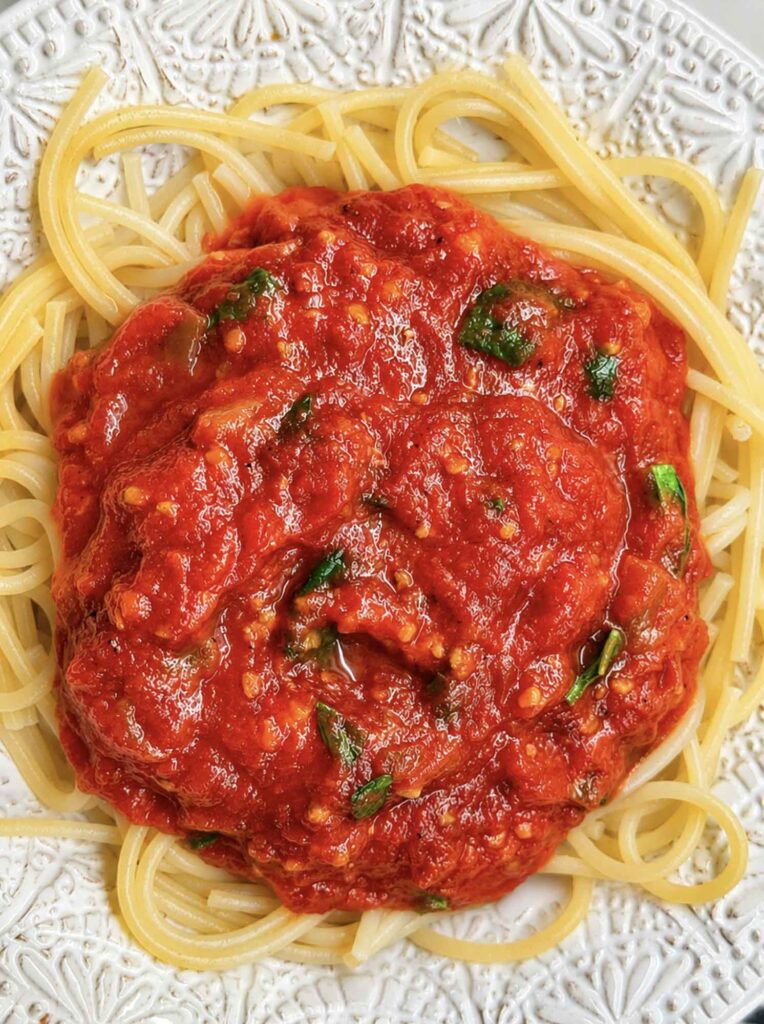
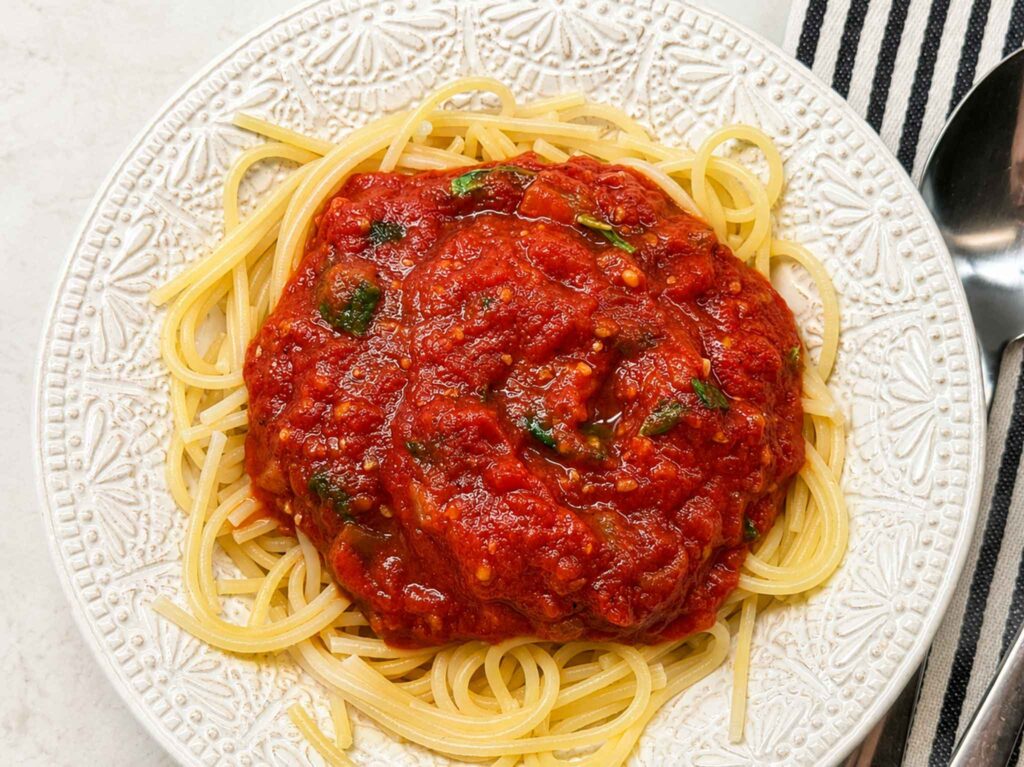
This homestyle spaghetti sauce recipe is a smooth-but-chunky tomato basil sauce made entirely from pantry staples: canned tomatoes, tomato paste, onion, garlic, olive oil, and a handful of fresh basil at the end if you have it. It takes about 10 minutes of prep and 30 to 45 minutes of gentle simmering, and it makes 4 to 5 cups of rich, lightly sweet sauce… the kind you’d normally pour out of a jar, except this one tastes fresher.
The Homemade Tomato Basil Sauce That Beat the Jar

I developed this recipe because I kept reaching for those tomato basil sauces in jars, the smooth ones with a little texture and a gentle sweetness, and I wanted to make that same sauce myself from scratch. So I tested it in my kitchen here at Maker Farm until I got it right, and I’ll just say it: this came out WAY better than the jar. In one batch I even used tomatoes I’d frozen from last year’s garden harvest in place of the crushed tomatoes, and some homemade tomato sauce, and they both worked great.
I’m picky about sauces that are too sharp or too sweet, so this one is balanced to sit right in the middle… and you can nudge it either way to suit your family.
Let’s dig in!


Want to Save This Recipe?
Enter your email below and we’ll send it straight to your inbox! Plus you’ll get new recipes each week!
Why Make Spaghetti Sauce from Scratch?
I’ll be honest with you: this sauce probably won’t save you money. A decent jar of tomato basil sauce often costs less than the cans that go into this pot. So why make it? Because homemade means you control everything: how sweet it is, how salty it is, whether there’s any heat at all. Jarred sauces decide all of that for you. Because fresh basil stirred in at the end tastes brighter than basil that’s been sealed in a jar for months. And because I can make a double batch for the freezer, tuned exactly the way we like it. You can’t buy that part for $2.50.
What Do You Need to Make This Spaghetti Sauce?
Everything here is a regular grocery store ingredient. The full amounts are in the recipe card below, so let’s talk about why each one earns its place.
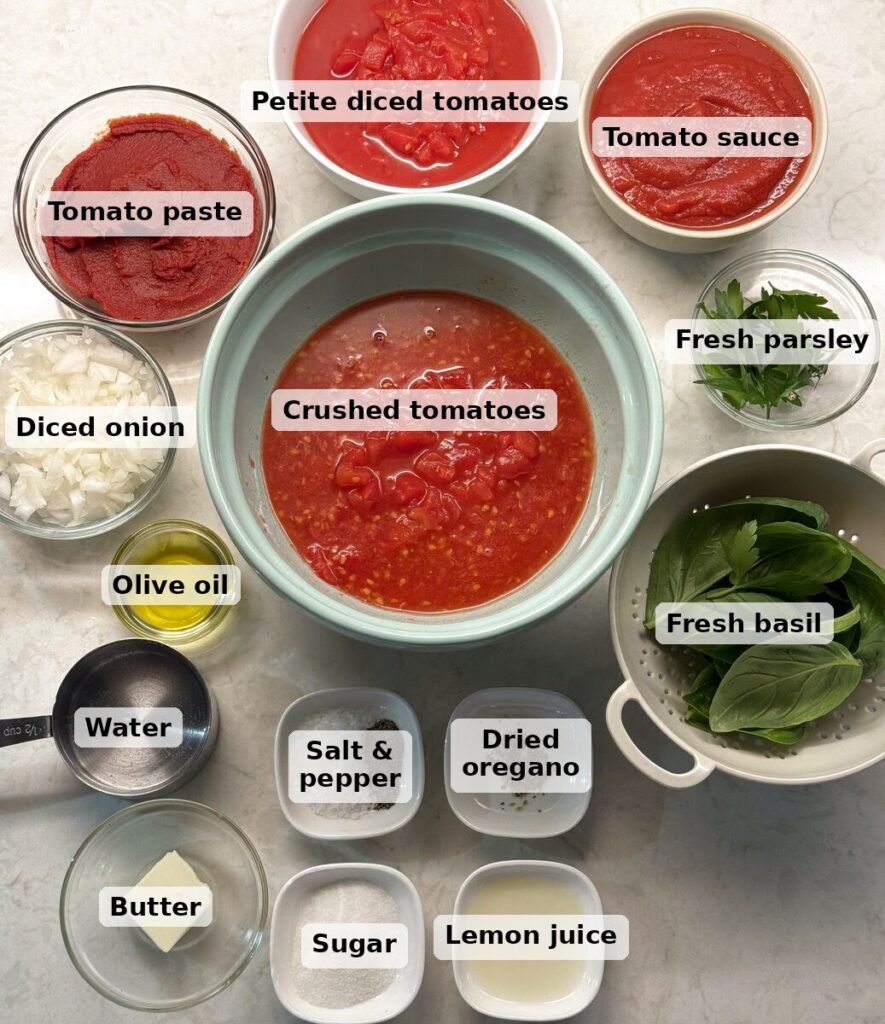
Four kinds of canned tomato. This sounds like a lot, but each has a job. Tomato paste gives the sauce its deep, rich backbone. Tomato sauce makes it smooth and pourable. A big 28-ounce can of crushed tomatoes (or tomato puree, whichever you have) gives it body. And an undrained can of petite diced tomatoes gives you those little tender pieces of tomato that make the sauce feel homestyle instead of processed.
Onion and garlic. One small yellow onion, finely diced, and four cloves of garlic. Dice the onion small so it melts into the sauce as it simmers.
Sugar. Just 1 1/2 teaspoons. Canned tomatoes can taste sharp and acidic, and a little sugar rounds that edge off. The goal is gentle sweetness like the jarred tomato basil sauces, so taste as you go and add a pinch more if your tomatoes are extra tangy.
Fresh basil. 8 to 12 leaves, chopped or torn, stirred in during the last 5 minutes. I’d keep the basil fresh here if you can. Adding it near the end helps because the basil stays bright instead of cooking down into the background.
NO FRESH BASIL?

Don’t worry… use 1 teaspoon of dried basil instead, and add it with the parsley and oregano during the simmer rather than at the end. Dried basil needs that cooking time to soften and release its flavor. The sauce will taste a little more mellow and cooked-in, closer to the jar, and it’s still very good.
The optional finishers. A teaspoon of lemon juice if the finished sauce tastes a little flat, and a tablespoon of butter if you want that smoother, rounder, jar-sauce-style finish. I’ll tell you when to decide on each one.
Can I use fresh or frozen tomatoes instead of canned?
Yes! I used tomatoes I’d frozen from last year’s garden harvest in place of the canned crushed tomatoes, and they worked great. Thaw them first, slip off the skins (they come right off frozen tomatoes), and crush them with clean hands, a potato masher, or an immersion blender until they’re mostly smooth with a little texture still left in there. You may need a few extra minutes of simmering since garden tomatoes carry more water than canned.
How Do You Make Spaghetti Sauce from Scratch?
We’re really building this sauce in two stages: building the flavor base, then letting everything simmer together. None of it is hard, I promise. I’ll walk you through each stage, and the recipe card below has the complete step-by-step version.
Step 1: Soften the onion and garlic
Warm the olive oil in a large saucepan over medium heat, add the diced onion, and cook it for 5 to 7 minutes until it’s softened and translucent. Be careful not to let it brown… browned onion changes the flavor of the whole sauce. Then add the garlic and cook it for just 30 seconds, until fragrant. One common mistake is walking away from garlic at this stage. It burns fast and turns bitter, so stay close (ask me how I know).
Step 2: Cook the tomato paste
Stir in the tomato paste and cook it for 2 to 3 minutes, stirring often, until it darkens slightly and smells richer. Don’t skip this step! The reason it matters is that raw tomato paste tastes tinny and flat, and a few minutes in the hot oil caramelizes its sugars and turns it deep and savory. This is the step that makes the sauce taste like it simmered all day.
Step 3: Simmer the sauce
Add the tomato sauce, crushed tomatoes, petite diced tomatoes, water, sugar, salt, parsley, pepper, and the oregano and red pepper flakes if you’re using them. Stir well, bring it up to a gentle simmer, then drop the heat to low and let it go uncovered for 30 to 45 minutes, stirring occasionally. Simmering uncovered helps because the extra water cooks off and the flavors concentrate. A little spatter around the stove is totally normal with tomato sauce… keep the simmer gentle and it stays manageable.
So how do you know when it’s done?

Dip your spoon in and look at the back of it. If the sauce coats it and a knife drawn through leaves a clean line, you’re there. Still not sure? Spoon a little onto a plate… if watery liquid seeps out around the edge, give it another 10 minutes and check again. Don’t worry about the clock. Every stove simmers a little differently, and the spoon knows better than the timer does.
Step 4: Taste and finish
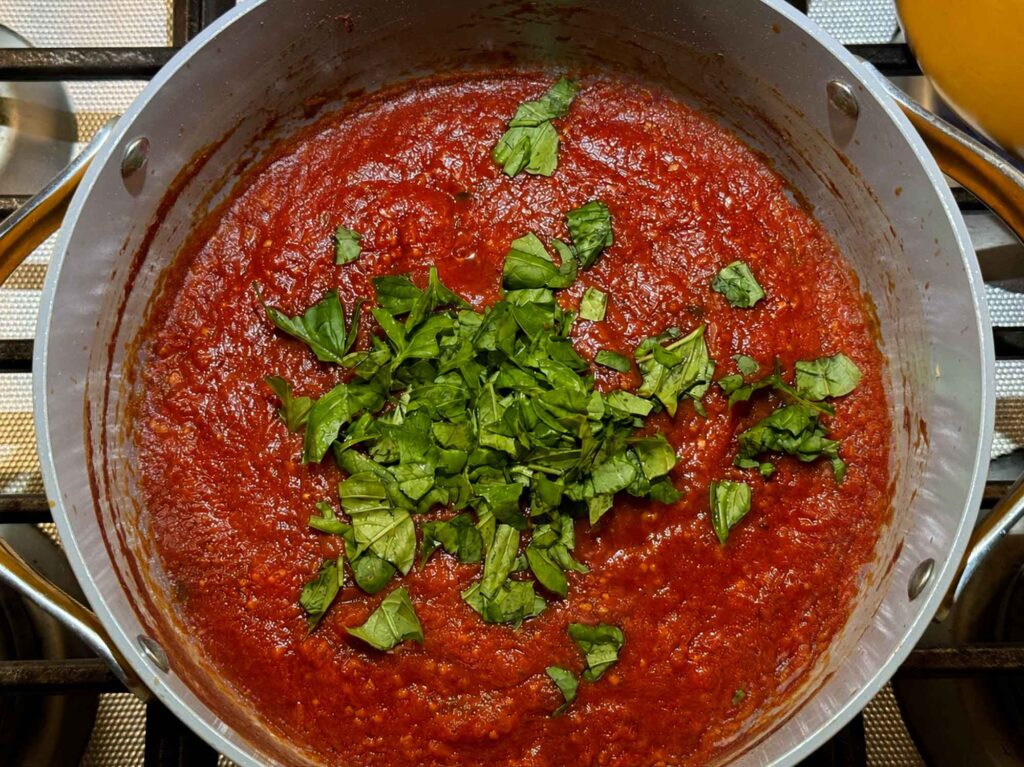
Now comes the fun part: making it taste exactly right. If the sauce gets too thick, add a splash of water. Too sharp? Another small pinch of sugar. Tastes flat? A little more salt usually wakes it right up. Stir in the fresh basil during the last 5 minutes. Then decide on your finishers: a teaspoon of lemon juice only if the sauce needs brightness, and a tablespoon of butter if you want it smoother and rounder, closer to that silky jar-sauce texture. Don’t worry about getting it perfect on the first taste… adjusting at the end is exactly how this sauce is designed to work.
How Do You Store and Reheat Homemade Spaghetti Sauce?
Let the sauce cool, then store it in an airtight container in the refrigerator for 4 to 5 days. It also freezes beautifully for up to 3 months… I like to freeze it flat in freezer bags so it thaws quickly and stacks neatly. To reheat, warm it gently in a saucepan over low heat with a splash of water if it’s thickened up. The flavor is even better on day two, after everything has had time to mingle.
CAN YOU CAN THIS?

This recipe hasn’t been tested for safe home canning, and the olive oil and butter make it a poor candidate anyway… so if you want to put some away, the freezer is your friend here. Frozen flat in bags, it keeps for up to 3 months and thaws in minutes.
Spaghetti Sauce FAQs
Can I add meat to this sauce?
Sure. Brown a pound of ground beef (I’d use 85/15) or Italian sausage in the pan first, drain most of the fat, then push it aside and build the sauce right on top of it, starting with the onion.
How do I make the sauce smoother or chunkier?
For a smoother sauce, use tomato puree instead of crushed tomatoes and blend the petite diced tomatoes before adding them. For a chunkier homestyle sauce, use crushed tomatoes and leave the petite diced as-is. You can even smooth the finished sauce with an immersion blender if you change your mind at the end… whatever works for you.
Can I double this recipe?
Yes, and I’d encourage it. Use a Dutch oven or large pot, and expect the simmer to take closer to 45 to 60 minutes to thicken.
How much pasta does this sauce cover?
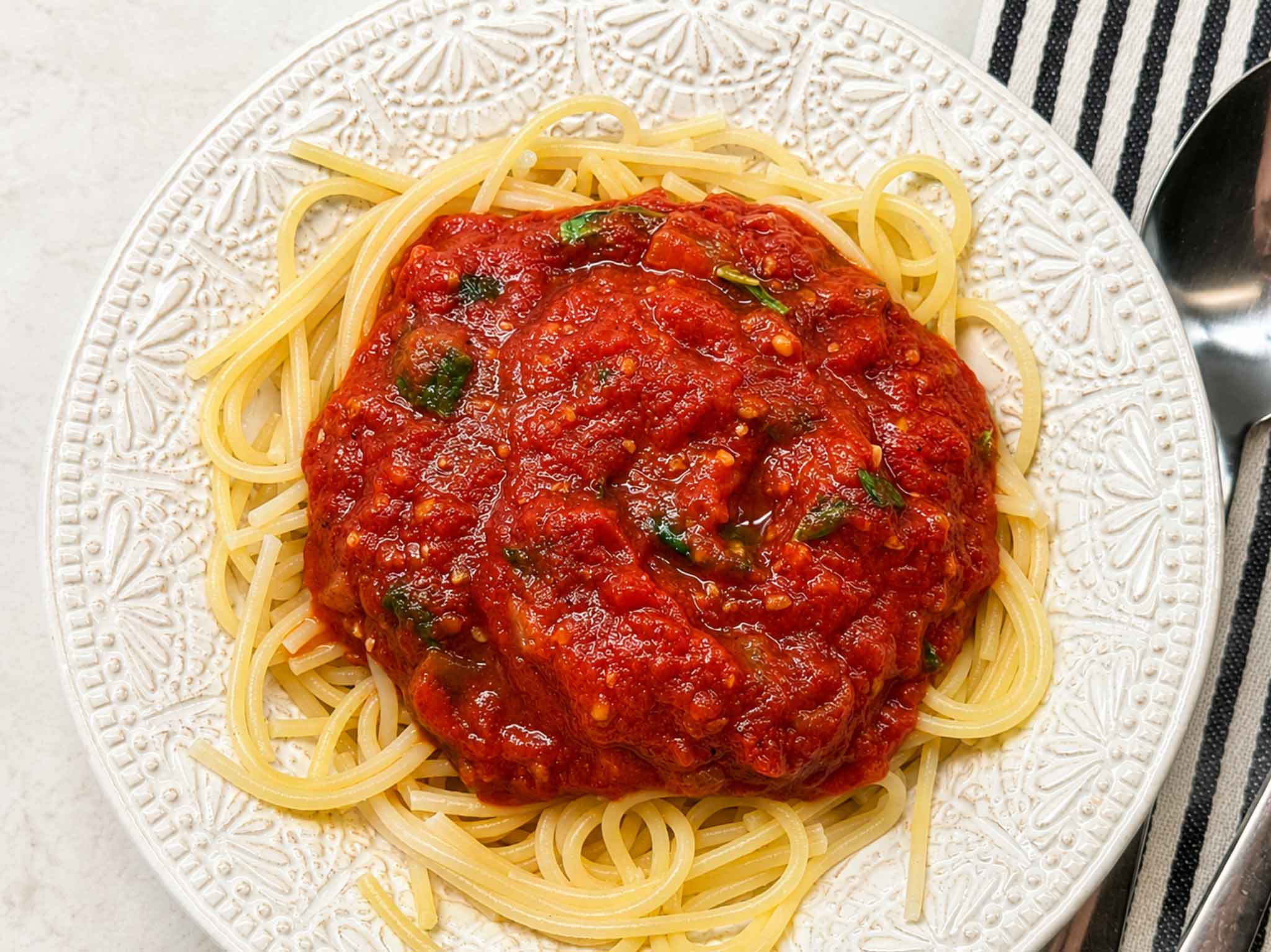
You’ll get 4 to 5 cups of sauce, enough for 1 to 1 1/2 pounds of spaghetti with a bit left over. I’d rather have too much sauce than too little… leftovers are SO GOOD spooned over just about anything.
Homestyle Tomato Basil Spaghetti Sauce Recipe
Ingredients
Ingredients
- 2 tablespoons olive oil
- 1 small yellow onion finely diced
- 4 cloves garlic minced
- 1 can (6 ounces) tomato paste
- 1 can (15 ounces) tomato sauce
- 1 can (14.5 ounces) petite diced tomatoes undrained
- 1 can (28 ounces) crushed tomatoes or tomato puree undrained
- 1/2 cup water plus more as needed
- 1 1/2 teaspoons sugar plus more to taste
- 1 teaspoon kosher salt plus more to taste
- 1/2 teaspoon dried parsley or 1 tablespoon fresh minced parsley
- 1/4 teaspoon black pepper
- 1/8 teaspoon Italian seasoning or just dried oregano, optional
- red pepper flakes Small pinch, optional
- 8 to 12 fresh basil leaves chopped or torn
- 1 teaspoon lemon juice optional
- 1 tablespoon butter optional
Instructions
Instructions
- Warm the olive oil in a large saucepan over medium heat. Add the onion and cook for 5 to 7 minutes, until softened but not browned.
- Add the garlic and cook for about 30 seconds, just until fragrant.
- Stir in the tomato paste and cook for 2 to 3 minutes, stirring often, until it darkens slightly and smells richer.
- Add the tomato sauce, petite diced tomatoes, crushed tomatoes, water, sugar, salt, parsley, black pepper, oregano (if using), and red pepper flakes (if using). Stir well.
- Bring the sauce to a gentle simmer, then reduce the heat to low. Simmer uncovered for 30 to 45 minutes, stirring occasionally, until the sauce thickens and the flavors come together. The sauce is ready when it coats the back of a spoon and a knife drawn through the coating leaves a clean line.
- If the sauce gets too thick, add a splash of water. If it tastes too sharp, add another small pinch of sugar. If it tastes flat, add a little more salt.
- Stir in the fresh basil during the last 5 minutes of cooking. Add the lemon juice at the end only if the sauce needs brightness. Stir in the butter at the end if you want a smoother, rounder finish.
Nutrition
Notes
Once you’ve made this sauce, you’ll want to keep a batch or two in the freezer for busy weeknights… future you will be very glad you did.
I love to use this homemade sauce for my easy lasagna recipe, meatball subs, and baked ziti, too! You can even use it on a sourdough pizza crust. It elevates everything it touches, much the way my easy chicken stock does.
If you make it, I’d love to hear how it turned out for you, and whether you went smooth or chunky!
Happy cooking!
Love,
Jennifer
Tried this recipe?
Tap the stars in the recipe card to leave a quick rating. Your rating helps other home cooks know this recipe works in a real kitchen, not just mine.
And as a thank-you for your feedback, you will receive a free printable copy of my Maker Home Companion Cookbook, featuring my most popular recipes, each one formatted on a SINGLE, easy-to-use page, a perfect kitchen companion for easy meal prep. Click here to learn more about this cookbook and how you can get your copy!


Meet Jennifer
Jennifer cooks and experiments in the kitchen at Maker Farm, where she focuses on simple pantry cooking, homemade staples, and practical recipes that make everyday meals easier. Over the years she has tested many ways to make cooking simpler and more dependable, and shares the methods that work best in her own kitchen, occasionally showing them on her Heart to Home at Maker Farm vlog.
Looks delicious, 5 ⭐️s for just the look.