

If you’ve ever wondered whether you can make a truly satisfying beef stew using only shelf-stable ingredients (so no need to have fresh food on hand), this recipe will show you exactly how. This is a hearty, savory beef stew made with canned beef, canned vegetables, and a simple blend of spices … no seasoning packets, no fresh ingredients required.

I’ve been cooking from a pantry more intentionally lately here in the Maker Farm kitchen, focusing on meals that are practical, reliable, and made from what we already have on hand. This stew came from that effort and has been refined over many meals. I made this version last night, and when Greg went back for more, I knew it was one worth sharing.
Why This Pantry Beef Stew Works
Most pantry stews fall short in two places:
- They taste flat without fresh ingredients
- Or they rely on pre-packaged seasoning mixes
This one solves both.
- Canned beef gives you a ready-to-use protein that you can keep in your pantry
- Dried minced onion + spices recreate that slow-cooked flavor
- Tomato paste + Worcestershire + bouillon build real depth
- Bacon grease adds richness that’s often missing
The result is a stew that feels complete, not like a substitute. And the “flavor profile” (Greg’s words, not mine!) is excellent… we REALLY love the taste of it!
Cooking with Canned Beef (What to Expect)
If you’ve never used canned beef before, this might feel like an unusual ingredient, but it’s one of the most useful pantry staples I keep on hand.
Canned beef is fully cooked, shelf-stable, and ready to use straight from the jar. It’s especially helpful on days when you don’t have fresh meat thawed or simply want to make a meal without planning ahead.
That said, it behaves a little differently than fresh beef.
- It’s already tender, so it doesn’t need long cooking
- It doesn’t have the browned flavor you get from searing raw meat
- The texture is more like shredded or pulled beef than chunks
Because of that, recipes like this one build flavor in other ways, using ingredients like tomato paste, Worcestershire sauce, dried onion, and bouillon to create depth and richness.
The result is a stew that feels hearty and complete, even without starting from raw ingredients.
Helpful Tip

If you’re new to using canned beef, you might notice small white pieces or solid bits in the can. That’s completely normal. Those pieces are beef fat that has solidified during storage. When the beef is pressure-canned, the natural fat melts and, when it cools, it solidifies into small white chunks. It’s perfect safe and expected, and in fact it is a sign that it hasn’t been over-processed or stripped of its natural fat. I always leave it in as it melts into the stew, adding richness and flavor, but you can remove some for a leaner stew if you prefer.
Mmm, This STEW IS REALLY GOOD. THIS IS ONE I’D SEEK OUT AGAIN.
Greg

Why I Keep Canned Beef in My Pantry
While I love cooking with fresh beef (my beef tips and gravy recipe stands out for this), it’s not always possible. So for me, having pantry recipes like this comes down to practicality. There are days when I don’t want to:
- thaw meat
- run to the store
- or spend hours cooking
Having canned beef on the shelf means I can still make something warm and filling with very little effort. I love fresh food, but it is expensive, sometimes hard to obtain, and can go to waste if not made fast enough.
Also, canned beef is generally more budget-friendly than fresh, and this matters. And canning does not heavily destroy nutrients, either. That said, it is still high in sodium from the canning process, so if this is an issue, be sure to rinse it first to remove 30-60% of the sodium.
It’s also part of a broader approach I’ve been working toward, keeping a pantry that can actually produce real meals, not just ingredients. This stew is a good example of that.
WHERE TO GET IT

I get canned beef from my local Meijer and Kroger stores, but if you cannot find it, it’s available from places like Amazon, too.

Want to Save This Recipe?
Enter your email below and we’ll send it straight to your inbox! Plus you’ll get new recipes each week!

Pantry Beef Stew Recipe
Equipment
Ingredients
Main Ingredients
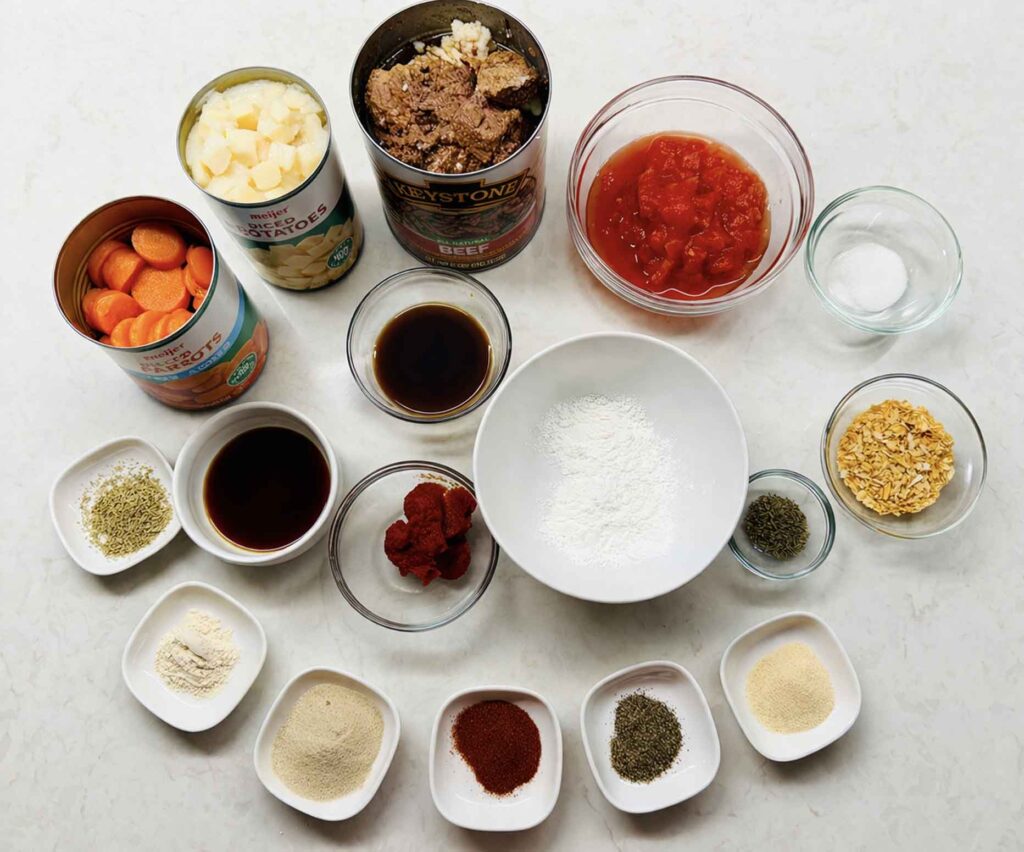
- 1 can of canned beef (I use a 28 oz. of Keystone canned beef)
- 1 can potatoes (drained, about 14–15 oz)
- 1 can carrots (drained, about 14–15 oz)
- 1/2 can diced tomatoes
- 2 cups water
- 2 tsp beef bouillon (adjust to taste)
- 2 Tbsp tomato paste
- 1 Tbsp Worcestershire sauce (optional, gives depth)
- 1 tsp soy sauce (optional, adds the "umami" flavor)
- 1/2 tsp sugar (optional, softens the acidity and rounds out harsh edges)
Seasoning Blend
- 2 Tbsp dried minced onion
- 1 tsp onion powder
- 1 tsp garlic powder
- 1 tsp paprika
- 1/2 tsp dried thyme
- 1/2 tsp dried rosemary (crushed)
- 1/2 tsp black pepper
- 1/2 tsp salt (add after tasting)
Optional (Recommended)
- 2 Tbsp cornstarch + 1/4 cup water
- 2 tsp bacon grease (or 1 Tbsp butter/oil)
Instructions
- Build the base. In a large pot, combine beef, water, bouillon, tomato paste, diced tomatoes, Worcestershire sauce, soy sauce, sugar, and all seasonings. Stir until everything is combined.
- Simmer to develop flavor.Bring to a gentle simmer and cook for 15 minutes. This step allows the dried onion to soften and flavors to come together.
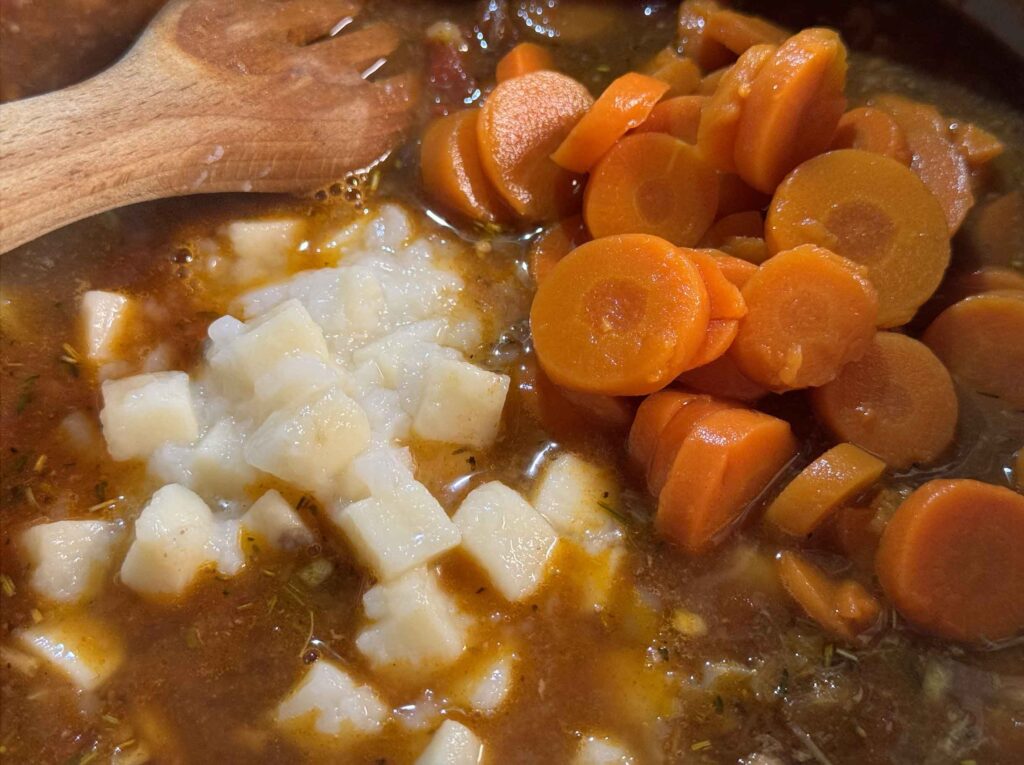
- Add vegetables.Add drained potatoes and carrots. Simmer for another 10-15 minutes, until just heated through.
- Thicken stew.Stir in the cornstarch and water slurry and cook for another 3-5 minutes, until lightly thickened.
- Finish and adjust.Stir in bacon grease (or butter/oil), then taste and adjust. Serve warm.
Nutrition
What Makes This Taste Like Stew Made With Fresh Ingredients
Without browning meat or using fresh ingredients, you have to build flavor differently. Here are the shelf-stable ingredients I add to make the canned food taste satisfying with complex flavors:
- Bouillon → backbone of the broth
- Tomato paste → concentrated richness
- Worcestershire sauce → depth and umami (don’t skip this one)
- Dried minced onion → that “cooked-in” flavor
- Bacon grease → richness and a hint of smokiness
Together, they recreate what you’d normally get from hours of cooking. Seriously! And all from foods you can store at room temperature for years.
Tips for Best Results
- Add canned vegetables later → prevents them from turning mushy (important!)
- Don’t over-thicken → a lighter broth tastes better with soft vegetables
- Taste at the end → bouillon brands vary in saltiness
- Start simple, then adjust → small changes make a big difference
Variations and Substitutions
- Use canned green beans, old-fashioned brown beans, or peas in place of carrots
- Use frozen veggies in place of canned ones, and cook for an extra 5 minutes
- Swap potatoes for canned white beans for a different texture
- Add a pinch of red pepper flakes for heat
- Use butter instead of bacon grease for a milder flavor

Using Fresh Potatoes and Carrots Instead
You can easily make this stew with fresh vegetables if you have them on hand.
What to Use
- 2–3 medium potatoes, peeled and cut into large chunks
- 2–3 carrots, peeled and sliced
How to Adjust the Recipe
The key difference is cook time. Instead of adding the vegetables later, add them earlier so they have time to soften:
- Build the base and bring it to a simmer (as written)
- Add the fresh potatoes and carrots
- Simmer for 25–30 minutes, or until fork-tender
- Then thicken and finish as directed
Which Should You Use?
Both work, it just depends on what you need that day.
Can You Use Fresh Beef Instead?
Yes, you can make this stew with fresh beef instead of canned. Just keep in mind that it becomes a different kind of recipe. The pantry version is designed to be quick and ready anytime, while fresh beef takes more time to become tender.
What to Use
- 1 to 1½ pounds stew beef (chuck works best), cut into chunks
How to Adjust the Recipe
- Brown the beef first
In your pot, cook the beef in a little oil over medium-high heat until browned on the outside. - Build the base
Add water, bouillon, tomato paste, diced tomatoes, Worcestershire sauce, and seasonings. - Simmer longer
Cover and simmer for 45–75 minutes, until the beef begins to tenderize. - Add vegetables
- Fresh potatoes and carrots: add now and cook 20–30 minutes more
- Canned vegetables: add in the last 10–15 minutes
- Thicken and finish
Add the cornstarch slurry and finish as directed.
What Changes
Using fresh beef:
- Adds deeper flavor from browning
- Creates a richer broth over time
- Requires more cooking time
Using canned beef:
- Is faster and more convenient
- Still produces a hearty, satisfying stew
- Works well for pantry-based cooking
Which Version Should You Choose?
- Use canned beef when you want a quick, reliable meal from your pantry
- Use fresh beef when you have time and want a more traditional, slow-cooked stew
What to Serve With This Stew
We just eat it with warm slices of sourdough bread. Bread is perfect for dipping into the stew. Here’s the delicious loaf of sourdough we made to go with it last night:

Storage and Reheating
- Store in the refrigerator for up to 4 days
- Reheat gently on the stove or in the microwave
- Add a splash of water if it thickens too much
WORTH IT!
Why I Keep Recipes Like This
It’s reassuring to KNOW you can make a good meal without needing to run to the store. This kind of cooking isn’t about shortcuts … it’s about having a system. A way to turn what you already have into something warm, filling, and worth sitting down to eat. I love the freedom this brings me, which is why I keep coming up with new recipes!
Related Pantry Recipes
Tried this recipe?
Tap the stars in the recipe card to leave a quick rating. Your rating helps other home cooks know this recipe works in a real kitchen, not just mine.
And as a thank-you for your feedback, you will receive a free printable copy of my Maker Home Companion Cookbook, featuring my most popular recipes, each one formatted on a SINGLE, easy-to-use page, a perfect kitchen companion for easy meal prep. Click here to learn more about this cookbook and how you can get your copy!




Meet Jennifer
Jennifer cooks and experiments in the kitchen at Maker Farm, where she focuses on simple pantry cooking, homemade staples, and practical recipes that make everyday meals easier. Over the years she has tested many ways to make cooking simpler and more dependable, and shares the methods that work best in her own kitchen, occasionally showing them on her Heart to Home at Maker Farm vlog.
Another great recipe for times to come, Jennifer! I made this for supper Saturday evening with a slight modification…the meat and bouillon. We do not eat red meat, so I cooked ground chicken and chicken bouillon and then used everything else in the recipe. It was delicious and so easy, which I can’t express how much that means. Easy and healthy is so important and needed in our lives these days. I swear the earth is spinning faster and our time is shorter…or at least it certainly feels that way! Thank you once again for caring and sharing!
This is an excellent change, Heather! I love that it worked with ground chicken and chicken stock. Mmm, sounds delicious!
I enjoyed this recipe. I am familiar with Keystone canned meats and love beef stew. I typically use stew meet and my meat never was a tender as with the Keystone beef. It was easy to make and just like the title say’s, I had everything in my pantry. I followed the recipe as written and I will definitely make it again and again.
Thank you SO much for letting me know, Lori! Happy to hear you enjoyed it!