

This slow cooker apple butter recipe turns apples into thick, dark, spoonable apple butter with cider, brown sugar, cinnamon, cloves, allspice, and nutmeg. The crockpot does the hard work, first softening the apples, then cooking the pulp down. Plan on about 30 minutes of hands-on time and 8 to 12 hours of mostly ignoring it. No pectin, no peeling, and no standing at the stove stirring.
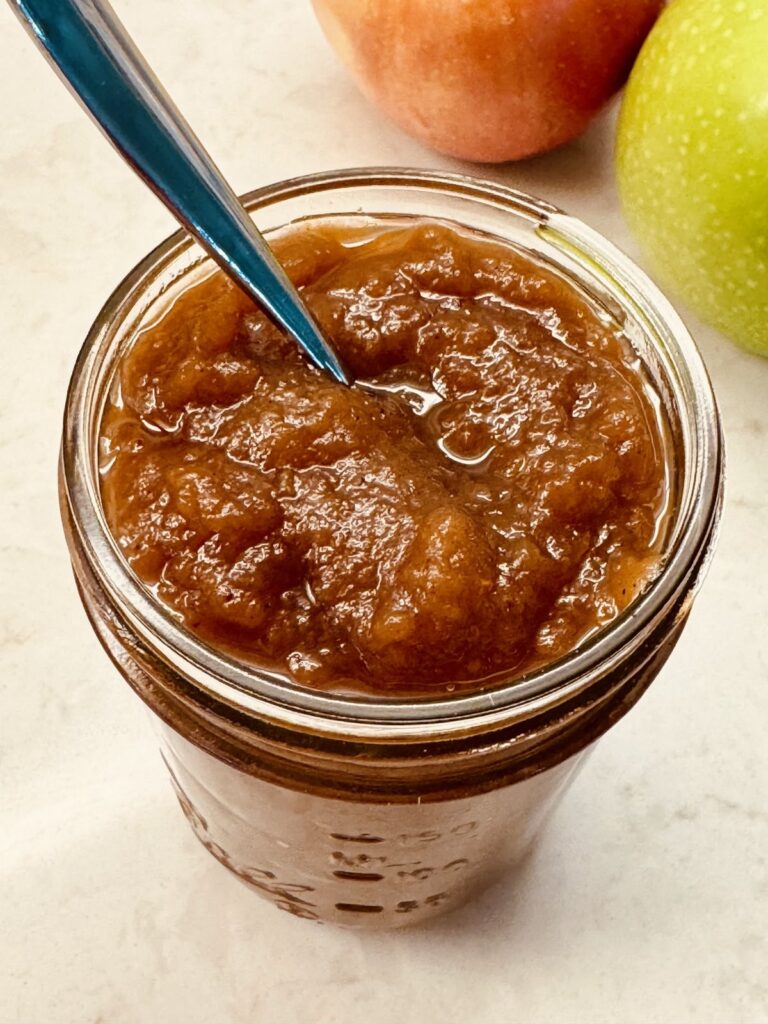
From a Bowl of Apples to a Sweet Spread

My home state, Michigan, is pure apple country. When I was a kid 50 years ago, I vividly remember going to a nature center where they had giant copper kettles of apple butter cooking. I got to take home a little jar of it. This recipe takes me right back to that moment in the autumn tasting my first bite, filled with all the amazement and wonder that apples can turn into something spreadable like this.
Most apple butter recipes are written for an enormous haul, a half bushel or more, and that’s a real commitment for something you may never have made before. So I took the tested Sweet Cider Apple Butter recipe out of the Ball Blue Book and cut it exactly in half. Then I added my own blend of seasonings. You can store a small batch in the refrigerator, or can it for the pantry, and I’ll explain how to do both.
Let’s dig in!

Tips and Notes Before You Start
- Your apples matter. While you can use any apples for apple butter, a mix of sweet and tart will give you a better flavor.
- Plan for a day. Apples soften for 3 to 4 hours on HIGH, then the pulp cooks down for another 3 to 5 with the lid cracked. Start it in the morning and you’ll be filling jars after dinner, so pick a day you’re going to be home anyway.
- Not canning? Skip the whole water bath section and just refrigerate or freeze it. Same recipe, no canner, no pressure.

Want to Save This Recipe?
Enter your email below and we’ll send it straight to your inbox! Plus you’ll get new recipes each week!
Why Make Apple Butter in a Slow Cooker?
Apple butter isn’t hard, it’s just long. All you’re really doing is cooking applesauce for hours and hours until the water leaves, the sugars caramelize, and the whole thing goes from pale gold to deep brown. On the stovetop that means a lot of standing and stirring, and a real risk of scorching, because thick fruit purees catch on the bottom of a pot fast.
A slow cooker mostly takes that problem away. The heat is low and it comes at the food from all sides instead of from one hot spot underneath, so you can start it and go do something else. You still stir now and then near the end, and I’ll tell you exactly when. The other reason I like the crockpot here is color. That slow, patient cook is what gives real apple butter its depth. Rush it and you get spiced applesauce, which is lovely, but it isn’t the same thing.
What You’ll Need for Slow Cooker Apple Butter
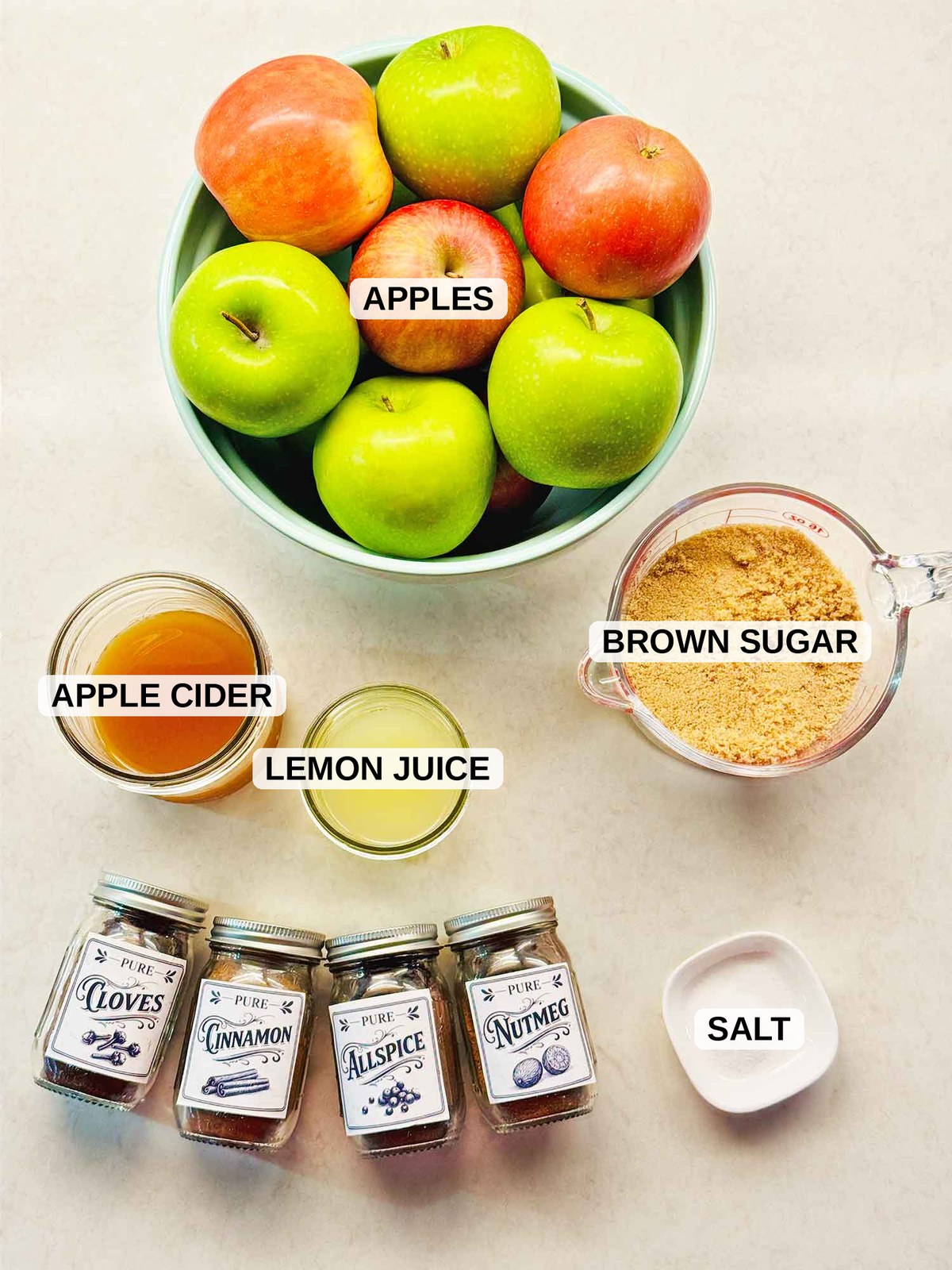
- Apples. A mix of sweet and tart gives you the most interesting flavor, and there’s more on varieties just below.
- Cider. Use the pasteurized kind. Real cider tastes far more like apples than clear juice does, and here it keeps the apples from sticking while they soften.
- Brown sugar. Ball’s original recipe calls for granulated white sugar. Brown sugar gives you a little molasses depth instead, which I like a lot in apple butter. Either one works.
- Lemon juice. Bottled, please, not fresh. This helps because acid is what makes apple butter safe to water bath can, and modern sweet apples run lower in acid than the old varieties did, so the recipe leans on a lemon juice with a standardized acidity to land the batch reliably in the safe range.
- Ground cinnamon, cloves, allspice, and nutmeg. These warm spices make all the difference in the taste.
- Salt. It may sound strange in a sweet spread, but it’s the thing that makes the apples taste more like apples.
What Are the Best Apples for Apple Butter?
The short answer is a mix. Sweet apples like Fuji, Gala, Golden Delicious, or Honeycrisp bring the fruit flavor, and a tart apple like Granny Smith keeps the whole thing from going flat and one-note on you. Mine was half Fuji and half Granny Smith. Balance them by weight instead of by count, because Granny Smiths often run smaller than the sweet varieties, and if you count out six of each you’ll land more tart than you meant to.
One thing worth knowing: firm apples take longer. Fujis and Grannies both hold their shape stubbornly, so if you’re using dense varieties like I did, cut them a little smaller and give yourself the long end of every time range in this recipe. Softer apples like McIntosh collapse much faster.
Do You Have to Peel the Apples?
I don’t peel! If you own a food mill or a food strainer, the peels get caught and left behind for you, and you skip what is easily the most tedious part of the whole day. The peels also add a little natural pectin and a little color while they cook.
If you’re planning to use an immersion blender instead, however, peel first. A blender doesn’t remove peel, it chops it into flecks, and you’ll feel them in the finished apple butter. Either path gets you to the same place, so pick the one that matches the tools in your kitchen.
How to Make Slow Cooker Apple Butter
First we cook the apples down into pulp, then we turn that pulp into apple butter. It helps to think of it that way, because there’s a natural stopping point in the middle where the pulp can sit covered in the fridge overnight if your day gets away from you.
Step 1: Cook the apples until they collapse
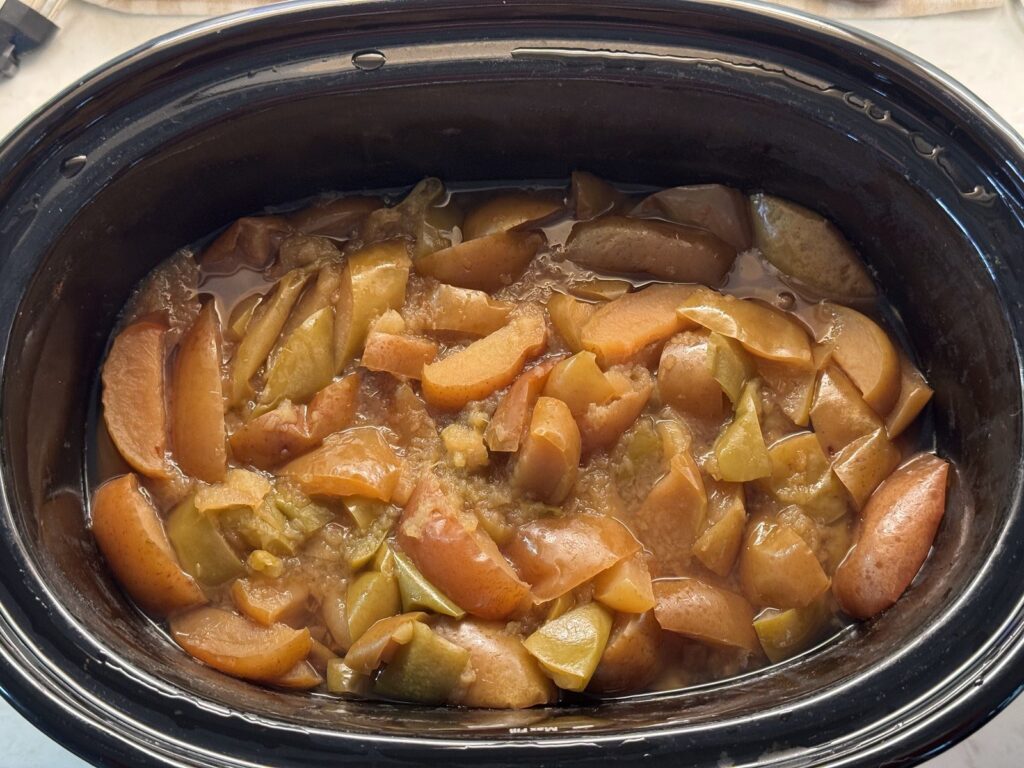
Wash and quarter the apples, coring as you go. If you’re not peeling, that’s the whole prep. Cut especially firm apples into eighths instead of quarters so they soften evenly. Put them in a 5-quart or larger slow cooker, pour the cider over the top, cover, and cook on HIGH for 3 to 4 hours or LOW for 6 to 8.
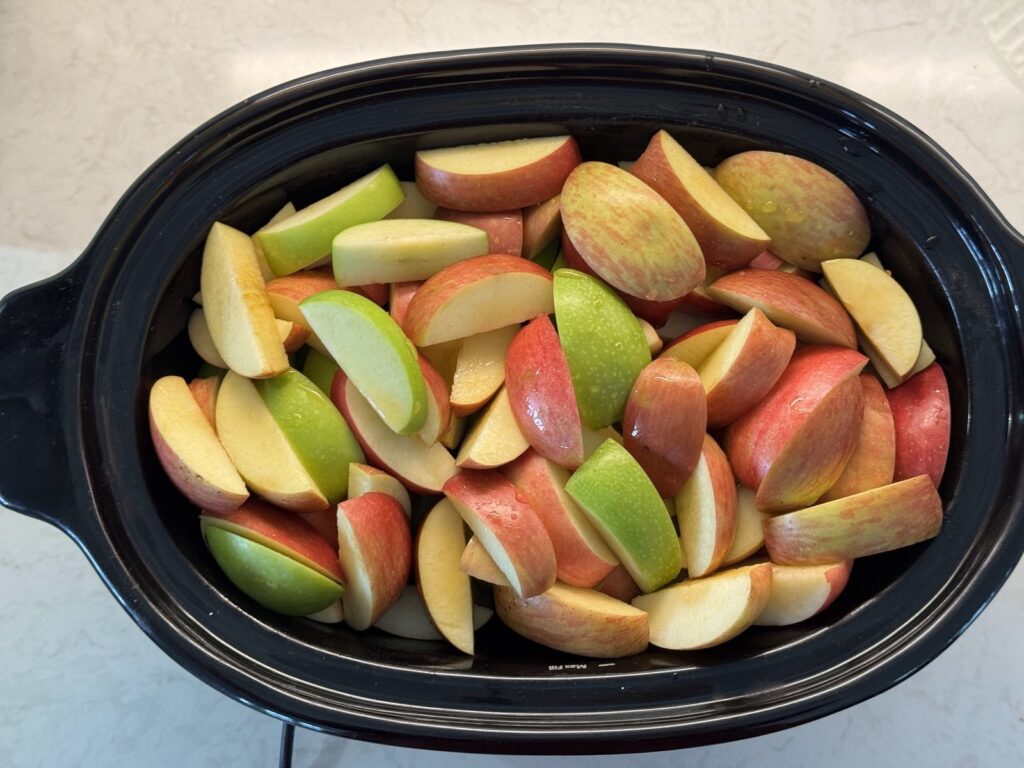
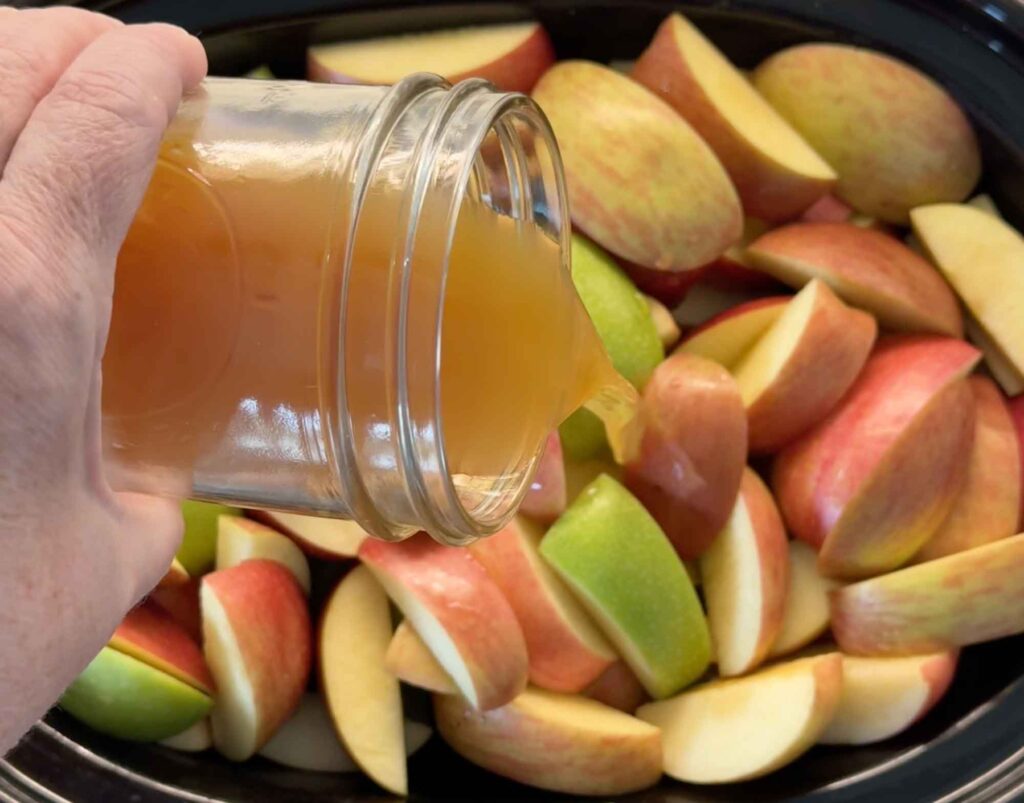
Don’t worry if the crock looks packed to the brim at the start… it settles a lot in the first hour. It may look dry in there too, and that’s fine. Apples are mostly water, and they’ll release plenty of it as they heat. One common mistake is adding extra liquid here because the pot looks thirsty, and all that does is give you more water to boil off later, which can add an hour or two to your evening. You’re done with this stage when a spoon slides through an apple piece with no resistance at all.
Step 2: Mill the pulp and measure exactly 6 cups
Run the soft apples through a food mill or a food strainer set over a bowl. The peels and any stray bits of core stay behind and the smooth pulp comes through underneath. If you peeled your apples, use an immersion blender right in the crock instead and puree until smooth.
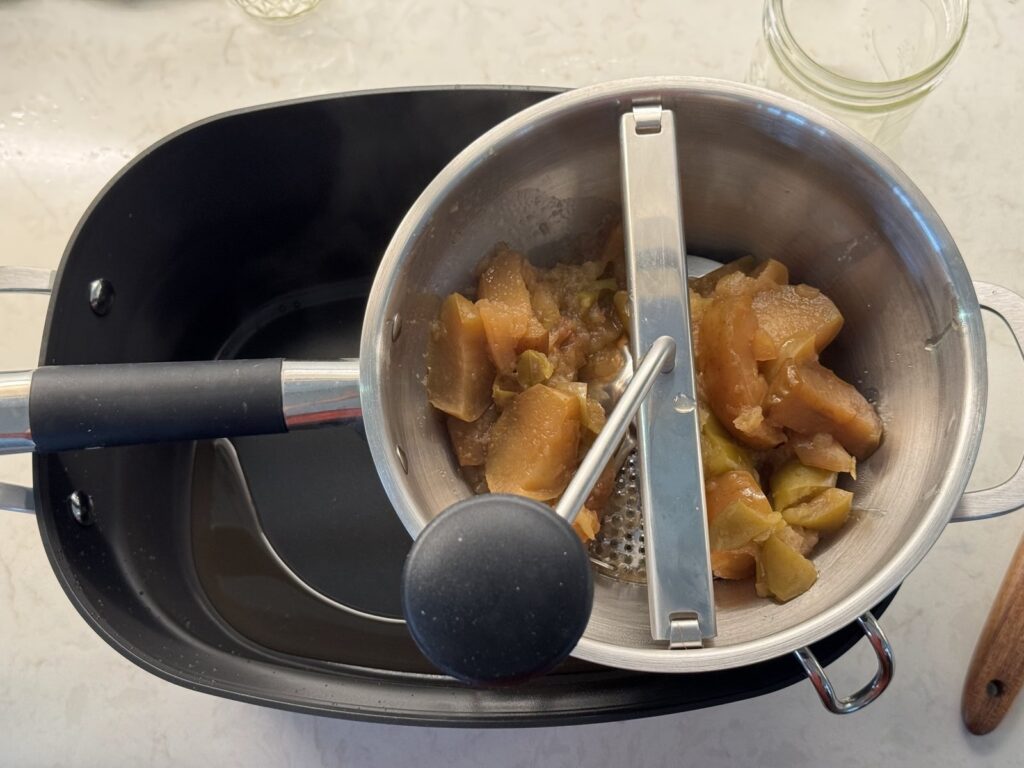
Now measure. If you plan to can this, you want exactly 6 cups of pulp going back into the slow cooker. If you have extra, cover it and put it in the fridge, because what you’re holding is applesauce, and it’s already better than anything in a jar since you can still taste the actual apples in it. If you come up short, that just means your apples ran small, and the easiest fix is to cook another apple or two and top it back up to 6. It’s okay if you land a half cup over, by the way. That’s tomorrow’s snack, not a failure.
This measurement matters so much because the lemon juice is calculated against the pulp, not against the raw apples you started with. Apples vary a lot in how much they yield. Locking the pulp at 6 cups is what keeps the acid where the tested recipe put it, and that’s the whole safety basis for water bath canning this. If you’re not canning, this doesn’t matter as much.
Step 3: Stir in the sugar, lemon juice, and spices
Return the 6 cups of pulp to the slow cooker, then add the brown sugar, bottled lemon juice, cinnamon, cloves, allspice, nutmeg, and salt. Stir until you can’t see any streaks of dry spice. Be careful not to leave a pocket of cloves sitting unstirred at the bottom, because it won’t spread itself out during the cook and you’ll find it later in one very medicinal spoonful.
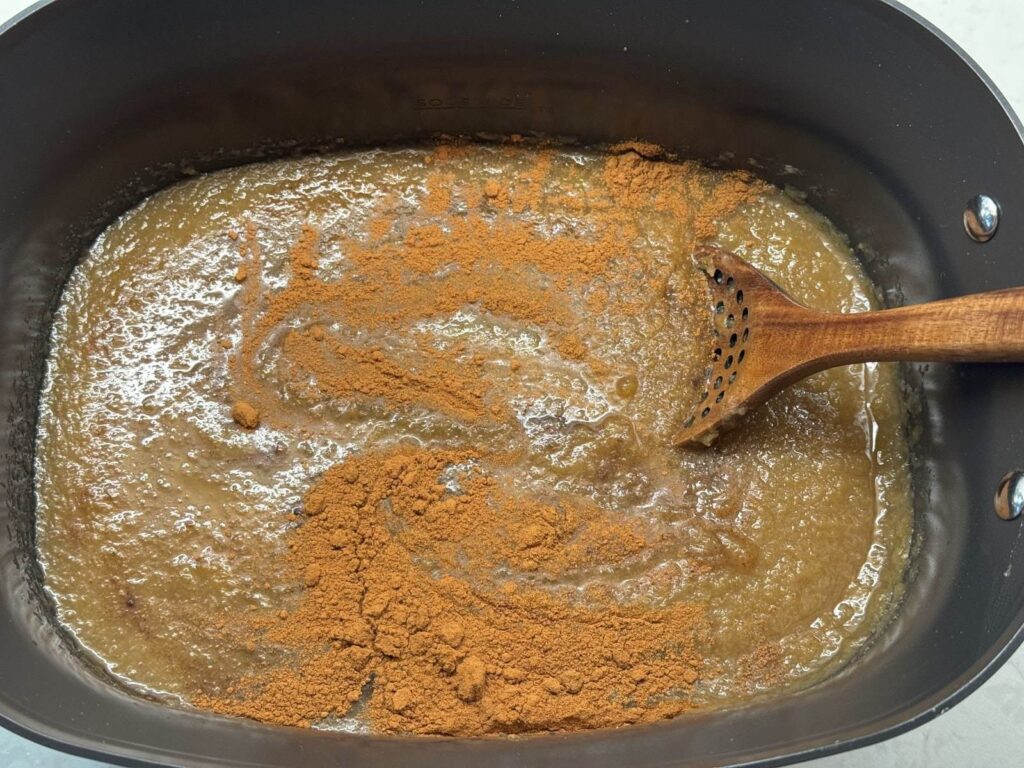
Taste it here, before the long cook. This is your one good chance to adjust, because everything gets more concentrated from this point forward. Want it sweeter? More brown sugar. More cinnamon? Add a bit more. Sugar and spice are both safe to change in a fruit butter, since apple butter gets its keeping power from acidity rather than from sugar. Just leave the lemon juice exactly where it is, in either direction.
Step 4: Cook it down with the lid cracked
Set the slow cooker to LOW, and this time either take the lid off or prop it open with the handle of a wooden spoon. That gap is the entire point of this stage. A sealed slow cooker traps the steam and drips it right back into the pot, so your apple butter will just stay thin no matter how many hours you give it. Give the water somewhere to go and it goes.
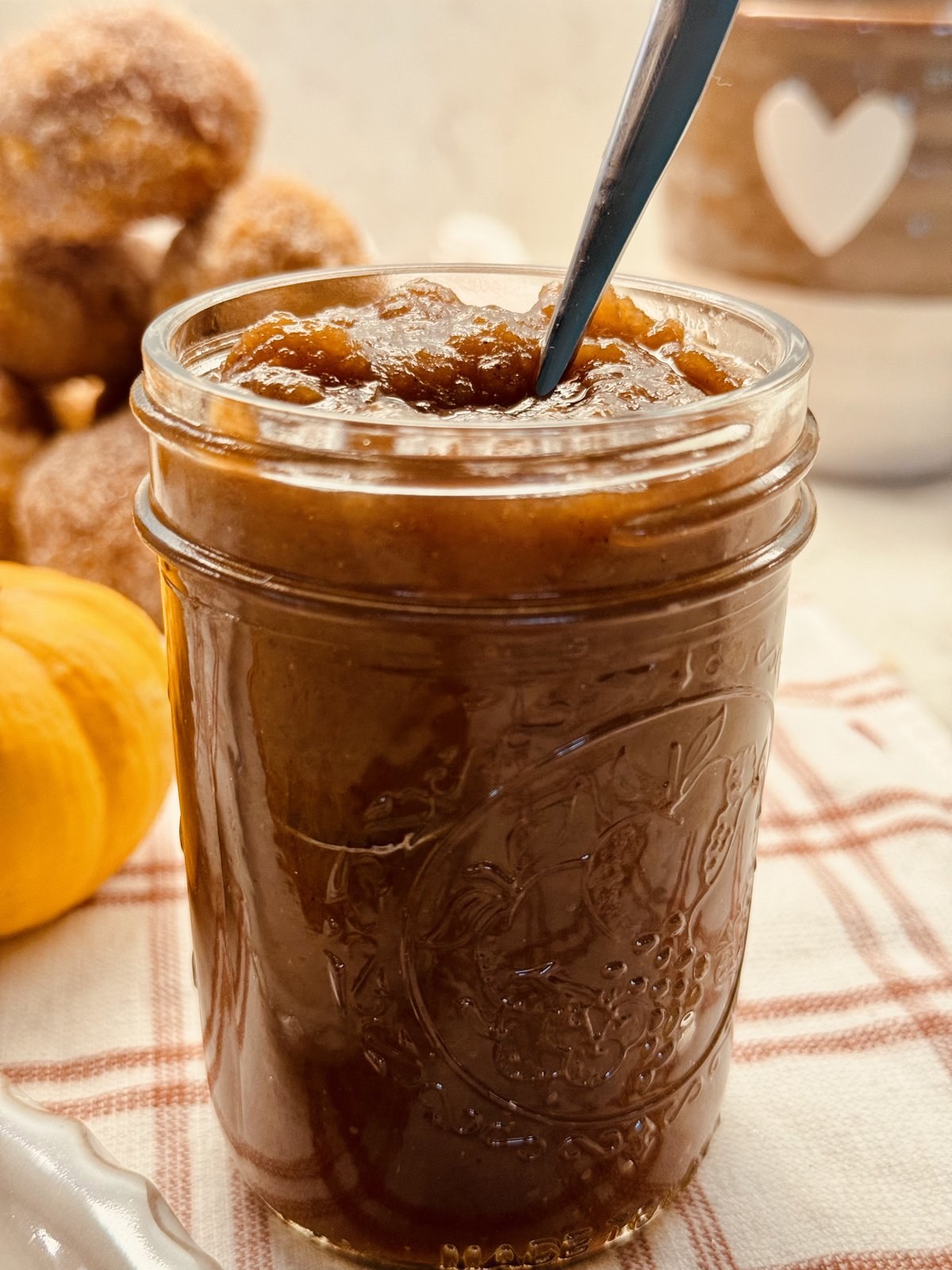
Depending on your slow cooker, this takes another 3 to 5 hours. Stir every 45 minutes or so at first, then more often as it thickens, because a thick puree will scorch on the bottom if you leave it too long. Ask me how I know (hey, I make the mistakes so you don’t have to!). You’ll watch it go from pale gold to caramel to a deep, glossy brown, and the smell in the house while that happens is SO GOOD.
How Do You Know When Apple Butter Is Done?
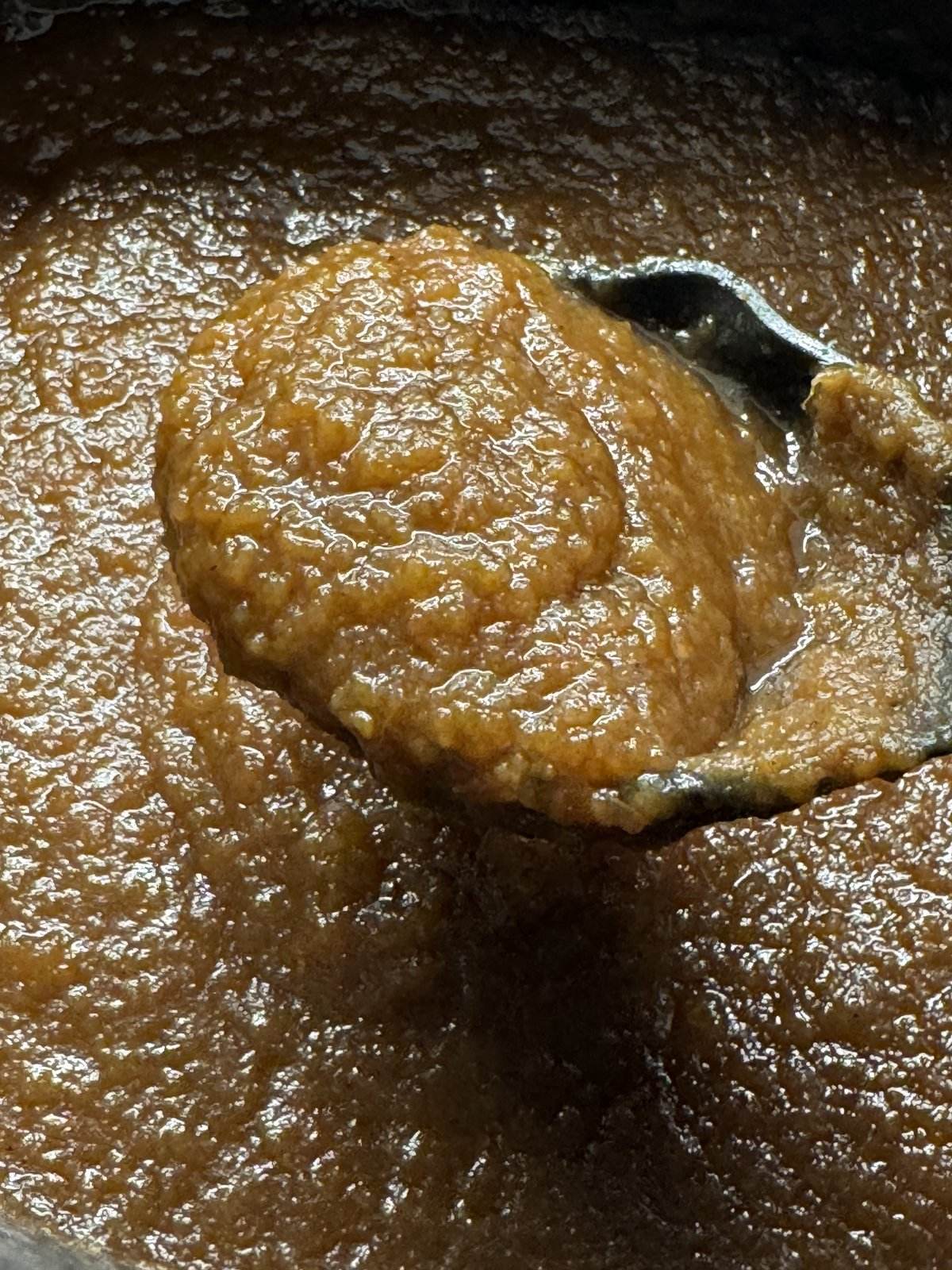
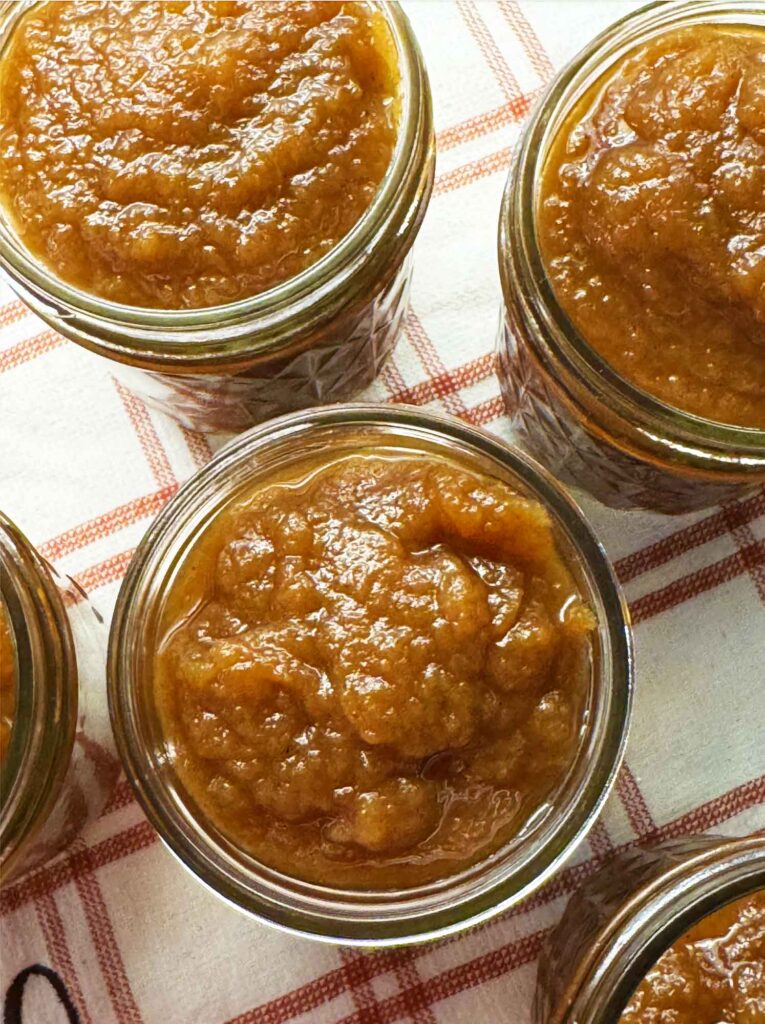
Spoon a little onto a cold plate and let it sit for a minute. If a rim of watery liquid seeps out around the edge, it needs more time. If the mound just sits there holding its shape with a clean edge, you’re done.
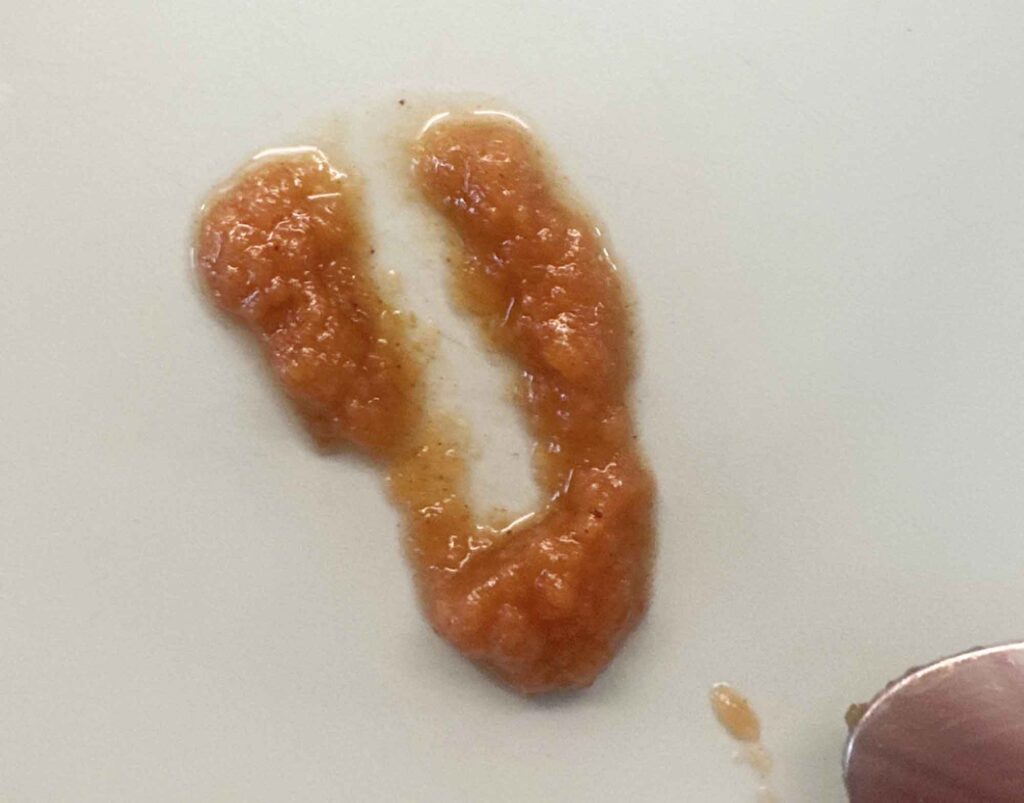
It’s okay if yours takes longer than mine did. Slow cookers vary wildly, some run a good deal hotter than others, and a batch made from very juicy apples simply has more water to lose. This is totally normal, and there’s no penalty for going long. Be careful not to take it too far the other way, though. Apple butter that sails past thick and lands on spackle needs a warm knife to get it out of the jar, and it doesn’t heat evenly in there either.
How to Can Apple Butter in a Water Bath
If you’re keeping it in the fridge or freezer, you can skip straight past this section. If you want jars on the shelf, here’s how it goes.
A QUICK WORD ON SAFETY FOR CANNING

The canning rules here come from people who test this for a living, and this recipe is adapted from the tested Sweet Cider Apple Butter in the Ball Blue Book Guide to Preserving (38th Edition), cut in half. You can read more about fruit butters at the National Center for Home Food Preservation. Spices are yours to play with. The apples, the cider, the bottled lemon juice, the pulp, the jar size, the headspace, and the processing time are the ones to keep exactly as written.
Start by getting the apple butter properly hot. A slow cooker is built to reduce, and it can’t reliably hold food at a high enough temperature to hot pack jars safely. So move the finished apple butter to a saucepan on the stove and heat it until it’s steaming and gently bubbling, stirring the whole time so it doesn’t catch on the bottom.
Meanwhile, get your half-pint jars hot and set up a boiling water canner according to the manufacturer’s directions. Then:
- Ladle the hot apple butter into hot half-pint jars, leaving ¼ inch of headspace.
- Slide a bubble tool around the inside to release air pockets, then check the headspace again and top up if you need to.
- Wipe the rims clean, set the lids on, and screw the bands down fingertip tight.
- Lower the jars into the canner. The water should cover them by at least an inch. Cover, bring back to a rolling boil, and process for 15 minutes, adjusted for your altitude.
- Turn off the heat, take the canner lid off, and let the jars sit in the water for 5 minutes before you lift them out.
- Cool undisturbed for 12 to 24 hours, then check the seals before labeling.
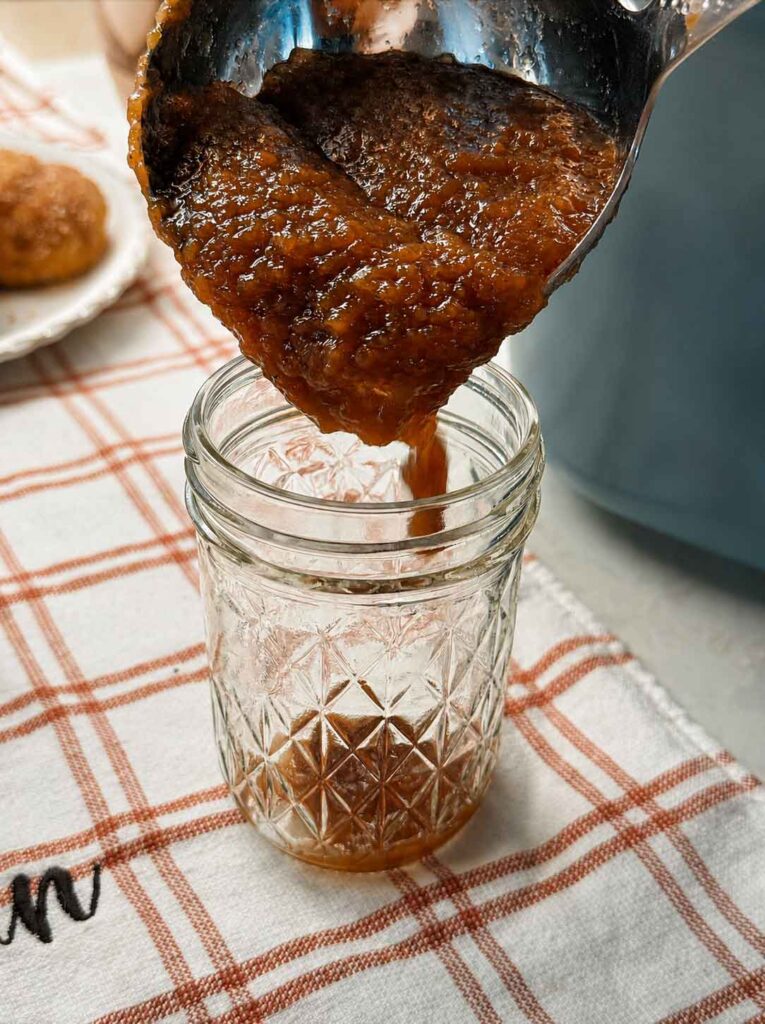
A dirty rim is the number one reason a jar fails to seal, so wipe them even if they look perfectly clean already. Be careful not to crank the bands down hard, either. Fingertip tight means you turn until you feel resistance and then stop, because air needs to escape past the lid while the jars are processing.
And if one jar doesn’t seal, don’t worry… it isn’t a disaster and it doesn’t mean you did anything wrong. That jar just goes in the refrigerator and gets eaten first, which around here is not much of a punishment.
| Your altitude | Process half-pints for |
|---|---|
| 0 to 1,000 feet | 15 minutes |
| 1,001 to 3,000 feet | 20 minutes |
| 3,001 to 6,000 feet | 25 minutes |
| Above 6,000 feet | 30 minutes |
We’re at about 900 feet here in Dexter, so 15 minutes is our number. If you’ve never done a water bath before, my canning green beans post walks through the whole setup in more detail, and sweet pickle relish is another gentle place to start on an afternoon.
How to Store Apple Butter
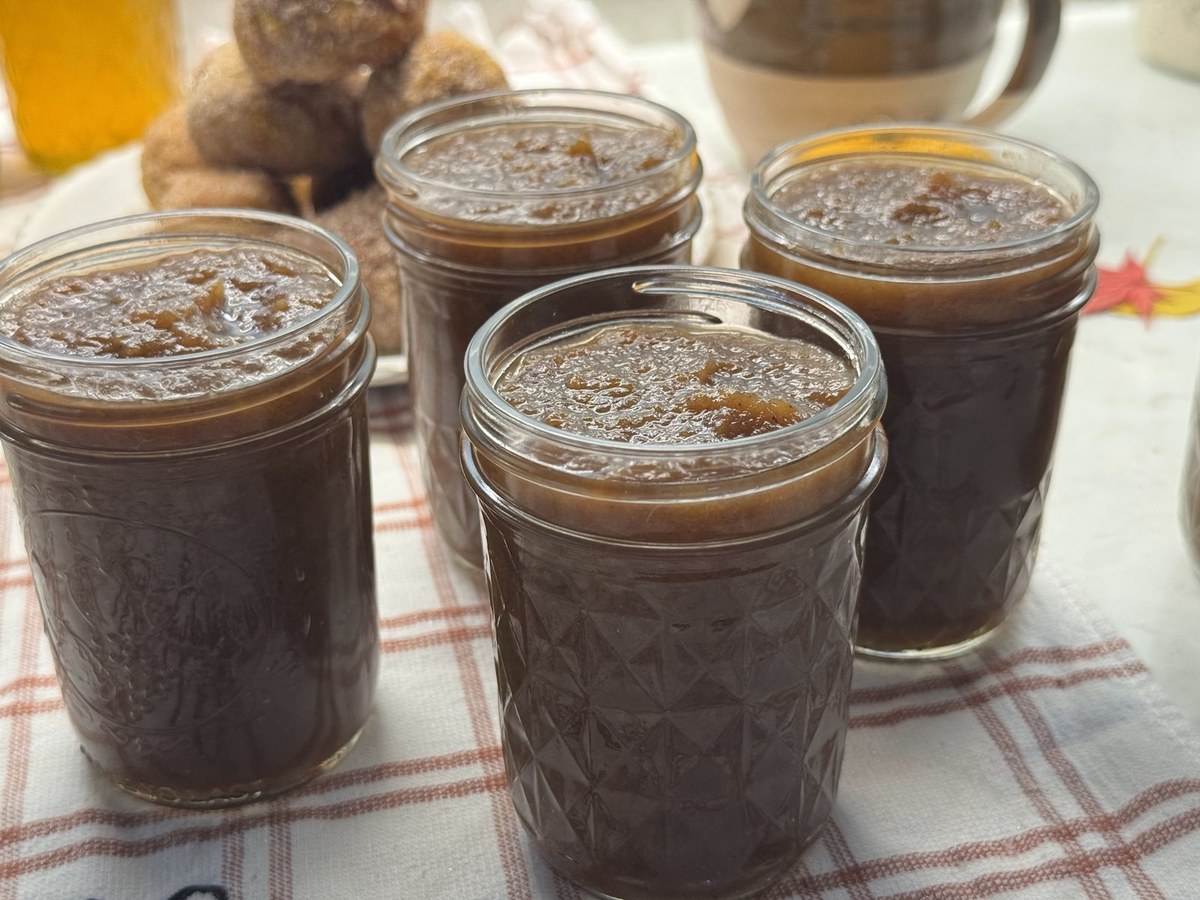
Sealed jars keep on a cool, dark pantry shelf for up to a year, and the flavor actually rounds out after a couple of weeks on the shelf. Take the bands off before you store them, because a band can hold a failed seal in place and hide it from you for months. Once you open a jar it lives in the fridge, and I’d use it within about three weeks.
If you’re not canning, cool the apple butter and refrigerate it in clean jars for up to three weeks, or freeze it. For freezing, leave an inch of headspace so it has room to expand, and it holds well for a year. Frozen apple butter thaws in the fridge overnight with no change in texture at all, which is not true of a lot of things you freeze.
What Do You Put Apple Butter On?
Toast is the obvious answer, and it’s the obvious answer because it’s the right one. A thick slice of sourdough with butter underneath and apple butter on top is most of the reason I made this.
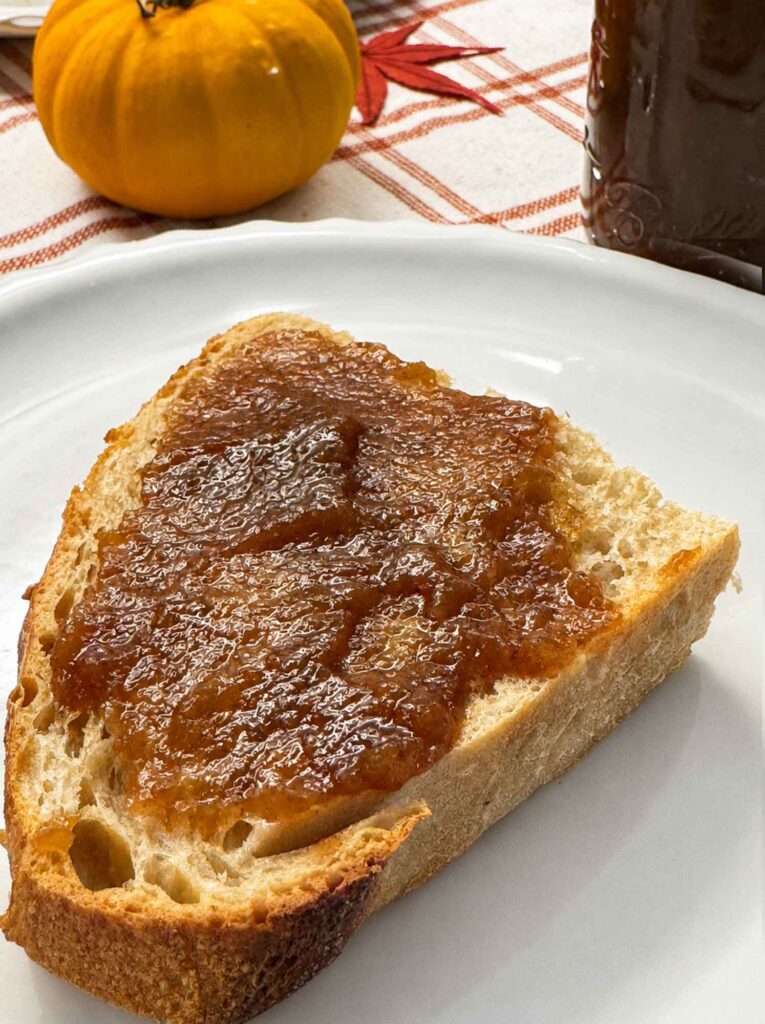
Past that, it’s good stirred into oatmeal, spooned over pork chops or a pork roast in place of applesauce, swirled into plain yogurt, spread on a biscuit, or used as the filling in thumbprint cookies. It’s also the easiest jar to hand somebody in the fall, making a fantastic gift.
Apple Butter Questions and Answers
Why is my apple butter still runny after hours?
If the lid was on, that’s your answer, and propping it open now will still get you there. If the lid was already off, give it another hour and turn the crock to HIGH for the last stretch, stirring more often as it tightens up.
Can I use less sugar or a sugar substitute?
You can. Apple butter is preserved by acidity, so the sweetness is a flavor decision rather than a safety one. It will be a little thinner and a little less glossy with less sugar, and it may want extra time to thicken.
Sugar substitutes are a bigger change. They don’t caramelize or add body the way sugar does, so you’ll get a thinner, lighter spread that tastes more like spiced applesauce.
Why did my apple butter separate in the jar?
A watery layer on top usually means it went into the jars a touch underdone. It’s still perfectly good, and stirring it back together when you open it fixes the texture.
What if a jar doesn’t seal?
Refrigerate that jar and use it within three weeks. You can also reprocess within 24 hours with a brand new lid, though honestly at one jar it’s rarely worth heating the canner back up.
Can I double this recipe?
You can double the ingredients, yes. But be aware that six cups of pulp already fills a 5 quart slow cooker most of the way once the lid comes off, so a double batch needs a larger slow cooker (I use the 8.5-quart Ninja Possible Cooker for a double batch). Cook-down time climbs quite a bit as well when you double the batch, just so you know.
Can I make apple butter in an Instant Pot instead?
You can soften the apples under pressure to save yourself the first few hours, and it works well. The thickening stage still has to happen with the lid off on sauté or in a slow cooker, because a sealed pot can’t lose the water it needs to lose.
Spiced Apple Butter Recipe
Equipment
- slow cooker 5 quart or larger
- food mill (or an immersion blender, if you peel the apples)
- boiling water canner if canning
Ingredients
- 3 pounds apples (about 9 to 12 medium), such as Fuji, Granny Smith, Golden Delicious, or a mixture
- 1 cup apple cider pasteurized
- 1.5 cups brown sugar packed
- 2 tablespoons lemon juice bottled
- 0.75 teaspoon ground cinnamon
- 0.25 teaspoon ground cloves
- 0.25 teaspoon ground allspice
- 0.25 teaspoon ground nutmeg
- 0.125 teaspoon salt
Instructions
- Wash, core, and quarter the apples. Peel them only if you plan to puree with an immersion blender. Cut especially firm apples into eighths so they soften more quickly.
- Place the apples and cider in a large slow cooker. Cover and cook on HIGH for 3 to 4 hours or LOW for 6 to 8 hours, until the apples are completely soft.
- Pass the apples through a food mill or food strainer, or puree them with an immersion blender. Measure exactly 6 cups (1½ quarts) of apple pulp. Refrigerate any extra pulp for another use.
- Return the 6 cups of pulp to the slow cooker. Stir in the brown sugar, bottled lemon juice, cinnamon, cloves, allspice, nutmeg, and salt until evenly combined. Taste and adjust the sugar and spices now if you want to.
- Cook on LOW with the lid off or propped open, stirring occasionally, until the apple butter is dark, concentrated, and thick enough to mound on a spoon, about 3 to 5 more hours. Stir more often as it thickens so it doesn’t scorch.
- Test for doneness by spooning a small amount onto a cold plate. It is ready when it holds its shape and no rim of liquid separates around the edge.
- Transfer the hot apple butter to clean jars or containers.
Canning Instructions
- Prepare clean half-pint jars and keep them hot. Prepare a boiling water canner according to the manufacturer’s instructions.
- Transfer the finished apple butter to a saucepan and heat it thoroughly, stirring frequently. It should be hot and gently bubbling when packed into the jars.
- Ladle the hot apple butter into hot half-pint jars, leaving ¼ inch headspace. Remove air bubbles, adjust the headspace if needed, wipe the rims, and apply lids and bands fingertip tight.
- Place the jars in the canner. Water should cover the jars by at least 1 inch. Cover the canner and return the water to a rolling boil.
- Process half-pint jars for 15 minutes at 0 to 1,000 feet. Add 5 minutes for 1,001 to 3,000 feet, 10 minutes for 3,001 to 6,000 feet, and 15 minutes above 6,000 feet.
- Turn off the heat, remove the canner lid, and let the jars stand in the water for 5 minutes. Remove the jars and cool undisturbed for 12 to 24 hours. Check the seals before labeling and storing.
Nutrition
Notes
More to Put Up This Fall
If this one hooked you, here’s where I’d go next.
- Canning Spaghetti Sauce with Meat
- Homemade Tomato Sauce from Fresh or Frozen Tomatoes
- Easy Apple Crisp with Buttery Oat Topping, for the apples you didn’t cook down
If you make it, come back and tell me how many jars you got and what apples you used.
Love,
Jennifer
Tried this recipe?
Tap the stars in the recipe card to leave a quick rating. Your rating helps other home cooks know this recipe works in a real kitchen, not just mine.
And as a thank-you for your feedback, you will receive a free printable copy of my Maker Home Companion Cookbook, featuring my most popular recipes, each one formatted on a SINGLE, easy-to-use page, a perfect kitchen companion for easy meal prep. Click here to learn more about this cookbook and how you can get your copy!
Meet Jennifer
Jennifer cooks and experiments in the kitchen at Maker Farm, where she focuses on simple pantry cooking, homemade staples, and practical recipes that make everyday meals easier. Over the years she has tested many ways to make cooking simpler and more dependable, and shares the methods that work best in her own kitchen, occasionally showing them on her Heart to Home at Maker Farm vlog.