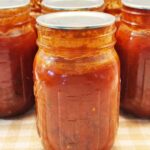
Canning Spaghetti Sauce with Meat
A tested pressure-canning method for spaghetti sauce with meat, seasoned like our homestyle sauce. Meat sauce is a low-acid food and must be processed in a pressure canner, never a boiling-water canner. Season to taste, but keep the tomato, meat, and vegetable amounts exactly as written, and do not add thickeners.
Equipment
- Large stockpot
- Slow cooker, optional, for the long reduction optional
- Jar lifter, canning funnel, ruler or headspace tool, plastic bubble tool
Ingredients
- 30 pounds tomatoes, fresh or frozen (or a mix)
- 2 1/2 pounds ground beef (85/15)
- 5 cloves garlic, minced
- 1 cup chopped onion
- 1 cup chopped celery or green pepper
- 1 pound fresh mushrooms, sliced, optional optional
- 2 tablespoons dried basil
- 2 tablespoons dried parsley (or 4 tablespoons fresh) or 4 tablespoons fresh
- 2 teaspoons dried oregano
- 4 1/2 teaspoons canning or kosher salt
- 2 teaspoons black pepper
- 2 tablespoons brown sugar
- 1/2 teaspoon red pepper flakes, optional optional
Instructions
- Wash the jars and bands in hot soapy water, rinse, and keep the jars hot. Prepare the lids per the manufacturer's directions. No need to pre-sterilize the jars.
- Prepare the tomatoes. Fresh: wash and core (no need to peel, the food mill removes the skins later). Frozen: thaw, slip off the loosened skins, and pour off some of the released water, then core. Quarter all of them.
- Cook the quartered tomatoes, uncovered, about 20 minutes, until soft. Run through a food mill or sieve to leave the skins and seeds behind and make a smooth pulp.
- Brown the ground beef; drain most of the fat. Add the garlic, onion, celery or pepper, and mushrooms (if using), and cook until the vegetables are tender.
- Stir the meat and vegetables into the tomato pulp. Add the basil, parsley, oregano, salt, black pepper, brown sugar, and red pepper flakes (if using). Taste and adjust the seasonings.
- Reduce the sauce until it cooks down by nearly half and is thick, either simmering uncovered on the stove or in a slow cooker set on high with the lid propped open, stirring occasionally. Do not add any thickeners.
- Just before filling, bring the sauce to a full rolling boil on the stove.
- Ladle the boiling sauce into hot jars, leaving 1 inch of headspace. Slide a plastic tool around the inside to release air bubbles, then recheck the headspace and top up if needed.
- Wipe the rims clean, center a new flat lid on each jar, and add the band until fingertip-tight.
- Set the jars on the rack in a canner prepared per your manual. Secure the lid with the weight off, heat until steam streams from the vent, and vent a full 10 minutes.
- Add the regulator weight at the correct pressure for your canner and elevation (weighted gauge: 10 pounds at 0 to 1,000 feet, 15 pounds above; dial gauge: 11 pounds to 2,000 feet, up to 14 pounds at higher elevations). Bring to full pressure, then process pints 60 minutes or quarts 70 minutes, holding pressure steadily. If it drops, return to pressure and restart the time.
- Turn off the heat and let the canner depressurize naturally. At zero, remove the regulator and open the lid away from your face. Lift jars straight up onto a towel and cool undisturbed 12 to 24 hours.
- Check the seals: a sealed lid curves down and does not flex. Remove the bands, wash, dry, label with contents and date, and store without bands in a cool, dark place. Use within about a year for best quality.
Notes
To serve, empty a jar into a saucepan and heat it through. This is the moment to make it taste fresh again: stir in a handful of torn fresh basil, a splash of olive oil, or a little grated Parmesan right before it goes on the pasta. I keep the fresh basil for serving rather than canning, so it stays bright.
